Slot Volatility Explained: Low, Medium & High Volatility
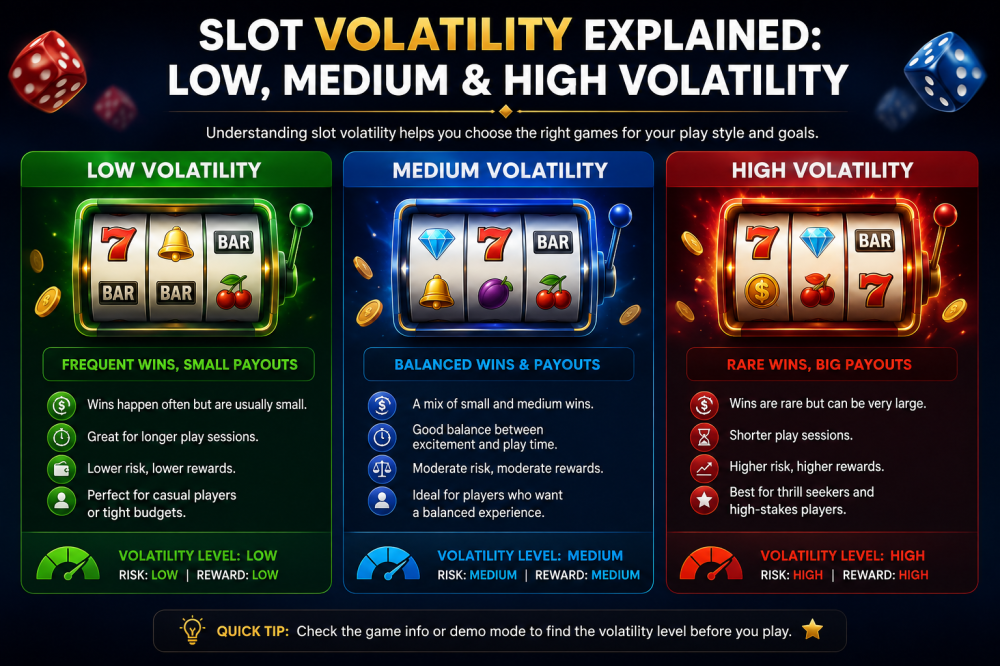
When researching online slot games, players often come across terms such as low volatility, medium volatility and high volatility. But what do these terms actually mean? Volatility is one of the most useful concepts to understand when comparing slot games because it gives players an idea of how frequently wins may occur and how much individual outcomes can fluctuate.
For example, two games could both advertise a similar RTP, yet feel completely different to play. One may produce smaller wins relatively frequently, while another may have longer stretches between notable wins but offer the possibility of much larger individual payouts.
Games available under platforms or providers such as Mega888, Pussy888, 918Kiss and JILI BET can have different volatility characteristics depending on the specific title. This guide explains what volatility means, how low, medium and high-volatility games differ, and how players can incorporate volatility into their game research.
Player Tip! Volatility describes the expected distribution and fluctuation of game outcomes. It does not predict the next spin, guarantee a particular frequency of wins, or indicate that a particular game is more likely to produce a profit. Always check the individual game's published information where available.
What Is Slot Volatility?
Slot volatility refers to how much a game's results can fluctuate over time. A simple way to understand it is to imagine two games.
- Game A has Lower Volatility. You might experience more frequent smaller wins, with individual results generally fluctuating less dramatically.
- Game B has Higher Volatility. You might experience longer periods without significant wins, while larger winning combinations can produce considerably bigger changes in your balance.
Neither is automatically "better". They simply offer different outcome profiles. This distinction is particularly important because players sometimes confuse volatility with RTP.
RTP vs Volatility: What's the Difference?
RTP and volatility answer different questions. RTP asks "What is the theoretical long-term return of this game?", while Volatility asks "How can the game's outcomes fluctuate around that long-term mathematical model?"
| Feature | Game A | Game B |
|---|---|---|
| RTP | 96% | 96% |
| Volatility | Low | High |
| Typical experience | More frequent smaller outcomes | Greater swings between outcomes |
| Risk of short-term fluctuations | Lower | Higher |
Both games have the same theoretical RTP. However, that doesn't mean they will feel anything alike during a short session. This is why experienced players generally look at RTP and volatility together.
The Three Main Volatility Levels
Slot volatility is commonly discussed using three broad categories:
- Low volatility
- Medium volatility
- High volatility
Some games may use more detailed classifications, such as very low, low-medium, medium-high or very high. There isn't necessarily a universal industry formula that places every game into exactly the same category, so players should treat these labels as useful guides rather than precise guarantees.
1. Low-Volatility Slots
Low-volatility games are generally associated with smaller fluctuations and more frequent winning outcomes, although this does not mean every spin will produce a win. Imagine starting with RM100. In a hypothetical low-volatility game, your session might look something like: RM100 > RM98 > RM101 > RM97 > RM103 > RM99. The balance is still moving, but the swings are relatively modest. This is only an illustration, not a prediction of how any actual game will perform.
What Does Low Volatility Feel Like?
Players may perceive low-volatility games as more consistent because smaller wins can occur more frequently. For example, you might see:
- Several small winning combinations
- Occasional moderate wins
- Fewer dramatic balance changes
- Smaller individual payouts compared with a high-volatility game
However, "more frequent wins" does not mean "more profitable". A player could receive many small wins while still losing money overall. Players who prefer a more gradual gameplay experience may naturally be interested in lower-volatility titles. For example, a player researching the Mega888 catalogue might compare several games and discover that one title has characteristics that appear less volatile than another. Instead of immediately searching for the game with the biggest advertised win, they could ask "Do I prefer frequent smaller outcomes or larger fluctuations?"
2. Medium-Volatility Slots
Medium volatility sits between the two extremes. These games may provide a mixture of smaller and larger outcomes, creating a more balanced fluctuation profile. Imagine another slot game starting with a RM100 session: RM100 > RM94 > RM108 > RM96 > RM115 > RM102. The balance may move more noticeably than in a lower-volatility example, but it isn't necessarily experiencing the larger swings associated with high volatility.
What Can Players Expect?
Many players researching online slots may find medium volatility an interesting category because it doesn't sit at either extreme. Medium-volatility games may appeal to players who want a combination of:
- Smaller winning combinations
- Occasional larger outcomes
- Moderate balance fluctuations
- Bonus features
- A mixture of different game mechanics
3. High-Volatility Slots
High-volatility games generally involve larger potential fluctuations between outcomes. This means a player could experience a series of spins without a significant payout, followed by a substantially larger winning outcome. Your slot game might look a little more like this: RM100 > RM92 > RM80 > RM67 > RM52 > RM118. The balance has moved considerably more than in the previous examples. But there's an important point: High volatility does not mean that a big win is coming. It simply describes a game where outcomes can have larger fluctuations. A player could experience: RM100 > RM85 > RM60 > RM35 > RM10 without ever hitting a significant winning combination.
So, Why Do Players Like High-Volatility Games?
One reason is the possibility of larger individual payouts. For example, imagine a player researching JILI BET games and finds a title featuring:
- Large multiplier mechanics
- Bonus rounds
- Special Wilds
- Large maximum-win potential
The player might find the game's mechanics interesting because of the larger potential swings. However, the trade-off is that higher volatility can also mean greater short-term financial fluctuations. This makes bankroll management particularly important.
A Simple Real-Life Example
Imagine two friends, Daniel and Amir, each decide to research a hypothetical slot with a RM100 entertainment budget. Daniel chooses a lower-volatility game. Amir chooses a higher-volatility game. After several spins, Daniel might experience: Small win > small loss > small win > small win > small loss. While in the same game, Amir might experience: Loss > loss > loss > larger win > loss > loss. Neither player's experience tells us which game is "better". They simply illustrate how different volatility profiles can create different gameplay experiences.
How Mega888, Pussy888 and 918Kiss Fit Into Volatility Research
When researching Mega888, Pussy888 or 918Kiss, it's better to look at volatility on a game-by-game basis. Don't assume "All Mega888 games are high volatility." Or "All Pussy888 games have frequent wins." Or "All 918Kiss games have the same volatility." A platform can contain many different titles, and each title may have its own mathematical configuration and mechanics. For example, a research table like this is much more useful than categorising an entire platform as simply "high paying" or "low volatility".
| Game | RTP | Volatility | Bonus Features | Notes |
|---|---|---|---|---|
| Game A | Check game info | Low | Free Spins | Smaller fluctuations |
| Game B | Check game info | Medium | Wild + Bonus | Balanced profile |
| Game C | Check game info | High | Multipliers | Larger fluctuations |
What About JILI BET?
JILI BET is another useful example because players can encounter different game formats and mechanics. Suppose you're comparing two JILI titles. One might have Lower volatility + straightforward gameplay, while another might have Higher volatility + multiplier and bonus mechanics. The second game may appear more exciting, but that doesn't necessarily mean it is mathematically more favourable. The question is whether you understand the risk and outcome characteristics of the game you're researching.
Does High Volatility Mean Higher RTP?
No. This is one of the most common misconceptions. RTP and volatility are separate characteristics. For example:
| Game | RTP | Volatility |
|---|---|---|
| A | 96% | Low |
| B | 96% | Medium |
| C | 96% | High |
All three have the same theoretical RTP. Yet their outcome distributions can be very different. Conversely, two games with different RTPs can also have similar volatility. Therefore don't use volatility as a substitute for RTP. Look at both factors before playing.
Does Low Volatility Mean Less Risk?
Not necessarily. This requires some nuance. Low-volatility games may generally produce smaller fluctuations, but that doesn't mean players cannot lose money. Suppose a player continuously places bets without setting a limit. Even relatively small losses can accumulate. For example RM1 loss × 100 spins = RM100. The fact that the game produces frequent small outcomes doesn't eliminate financial risk. Volatility describes the distribution of game outcomes, not whether gambling is financially safe.
Does High Volatility Mean Bigger Wins?
It can be associated with larger potential fluctuations, but this should not be interpreted as a guarantee of large wins. A game may have high volatility and still produce a losing session. This is why phrases such as "High volatility means you're more likely to hit the jackpot." should be treated cautiously. Volatility doesn't tell you when a win will occur.
Volatility and Bonus Features
Bonus mechanics can have a significant influence on how a game feels. Consider a slot with:
- Free spins
- 5× multipliers
- Expanding Wilds
- Bonus retriggers
These features could create substantially larger outcome fluctuations than a simple slot with straightforward payouts. This is one reason experienced players examine the entire game design, rather than looking only at the volatility label. When researching a game, consider RTP, Volatility, Bonus Mechanics, Bet Range and Maximum Win Information as a group.
What Is Variance?
You may also see the word variance used interchangeably with volatility. In online slot discussions, the two terms are often used to describe similar concepts. However, mathematically, variance has a more specific statistical meaning. For everyday slot research, you can generally think of volatility as describing how much game outcomes can fluctuate. If you're creating an educational website, it's better to explain this distinction rather than treating volatility as a precise prediction of how many spins will occur between wins.
How Should Beginners Choose Between Low, Medium and High Volatility?
There is no universally "correct" choice. Instead, think about the type of gameplay you are researching.
- Low Volatility. You may prefer this category if you are interested in Smaller fluctuations + potentially more frequent smaller outcomes
- Medium Volatility. You may prefer a mixture of smaller and larger fluctuations
- High Volatility. You may be researching greater swings + potentially larger individual outcomes.
But remember, potentially larger outcomes also come with potentially larger fluctuations.
A Practical Slot Research Framework
When investigating a new Mega888, Pussy888, 918Kiss or JILI game, consider using this five-step approach.
- Step 1: Check RTP. Find the published RTP for the specific game, where available.
- Step 2: Check Volatility. Determine whether the game is described as low, medium or high volatility.
- Step 3: Understand the Bonus Features. Look at Free spins, Wilds, Scatters, Multipliers, Bonus rounds, Jackpot mechanics.
- Step 4: Understand the Betting Range. Know the minimum and maximum stake before starting.
- Step 5: Consider Your Budget. Set a predetermined entertainment budget and avoid increasing it simply because you have experienced losses. This creates a much more informed approach to game research.
Common Volatility Myths
- "The game is cold because I haven't won recently." Not necessarily. A losing streak doesn't prove that a game is "cold".
- "A high-volatility game is more likely to pay soon." No. Volatility doesn't predict the next spin.
- "Low volatility means guaranteed small wins." No. Low volatility does not guarantee that every spin or session will produce a winning result.
- "High volatility is always better for experienced players." Not necessarily. Experienced players may understand volatility better, but that doesn't change the underlying randomness of the game.
- "The highest volatility game has the highest RTP." Not necessarily. RTP and volatility are separate characteristics.
Volatility and Responsible Bankroll Management
Understanding volatility becomes particularly useful when thinking about bankroll management. For example, a player researching a high-volatility game should recognise that their balance may fluctuate considerably more quickly than when playing a lower-volatility game. A sensible approach is to:
- Set a fixed entertainment budget.
- Decide on a session limit before starting.
- Avoid increasing bets simply to recover losses.
- Never use money needed for essential expenses.
- Avoid borrowing money to continue playing.
- Take breaks rather than playing continuously.
- Stop when the predetermined budget has been reached.
Volatility is essentially about how a slot's results can fluctuate.
Low-volatility games are generally associated with smaller, more frequent outcomes, while high-volatility games can involve larger fluctuations and potentially less frequent significant outcomes. Medium-volatility games sit between the two. But volatility should never be viewed as a prediction of what will happen next.
When researching Mega888, Pussy888, 918Kiss or JILI BET, don't simply ask "Which game has the highest volatility?" Instead, ask "What is this game's RTP, volatility, betting range and bonus structure, and how do these characteristics affect the type of gameplay it offers?" That is a much more useful way to evaluate a slot.
Most importantly, neither RTP nor volatility can guarantee a winning session. They are mathematical characteristics that help you understand a game's design, not tools for predicting individual spins.